







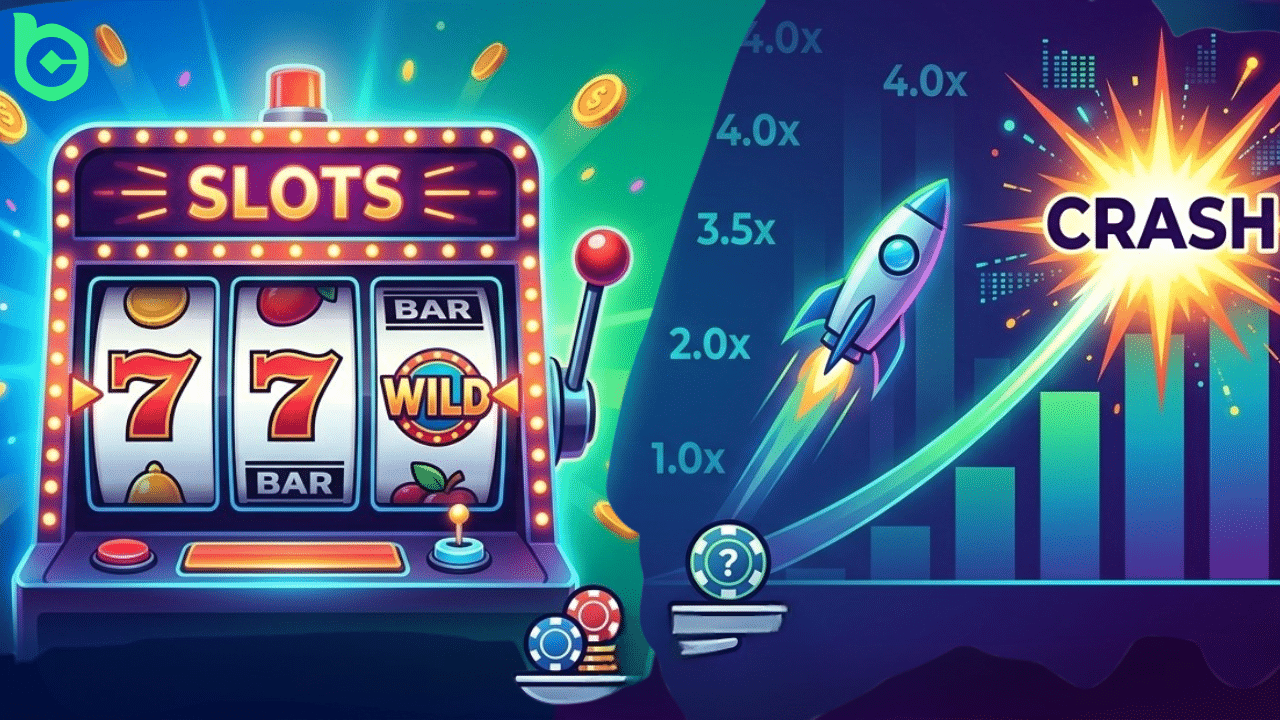
When you browse an online casino, two types of games always seem to grab the most attention: slots and crash games. On the surface, they couldn’t be more different. Slots are flashy, packed with themes, and move at a rhythmic, steady pace. Crash games are stripped-back, fast, and, to be honest, a little nerve-wracking. But if you look past the graphics and the sound effects, how do they actually compare when it comes to your chances of winning?
Most players choose based on what looks fun at the moment, but understanding the mechanics behind them can change how you approach your next session.
What “Expected Value” Actually Means
Before diving into the games, we have to talk about “Expected Value” (EV). This is just a simple way of saying how much you can expect to win or lose on a bet over a long period. In almost every gambling game, the math is set up so that the house stays ahead. This is the “negative EV” that players often talk about.
The most important thing to keep in mind is that both slots and crash games have a built-in house edge. There is no magic trick or secret “strategy” that turns them into a system that always makes money. The math is set in stone. The only real difference is how that house edge shows up during your play and how it affects your bankroll in the short term.
Slots: Fun, Flashy, and Built for the House
Slots are the most famous game in the lounge for a reason. They are easy to play: you hit a button, the reels spin, and you hope for a match. It’s a passive experience that doesn’t demand much from you other than your attention.
However, behind the animations and jackpot sounds, the math is very rigid. Most modern slots have a “Return to Player” (RTP) rate between 92% and 97%. At first glance, that sounds like you’re getting most of your money back, but in practice, it means the casino always has a lead that grows the longer you play.
Slots are also built on “volatility.” This is why they feel so unpredictable. You might spin for an hour without winning anything significant, and then suddenly hit a big payout. Or, you might just lose for a long time without seeing any return at all. Some slots have low volatility, meaning they pay out small amounts more often, while others are “high-octane” and feature massive swings. From an EV perspective, slots are very straightforward. The numbers don’t change based on your choices. You are essentially paying for the entertainment of watching the math play out.
Crash Games: The Illusion of Control
Crash games are a completely different beast. You don’t see reels spin; instead, you see a multiplier start to climb—1.2x, 2.0x, 5.0x, and sometimes much higher. It can “crash” at any second. If you haven’t clicked the “cash out” button before that happens, your bet is gone.
This feels much more engaging than a slot machine. You aren’t just a spectator; you are making a real-time choice. That ability to click a button and secure a win gives you a sense of agency. You feel like you are the one in charge of the outcome.
But behind the scenes, the game is still based on the same fundamental idea: over time, the odds are stacked in favor of the house. The system ensures that the frequency of crashes keeps the casino’s edge intact. Even if you use a “safe” strategy—like cashing out early every single round—the math is designed to account for that. The experience feels more strategic because you choose the exit point, but the underlying expected value doesn’t actually change.
Which One Has Better Value?
The answer isn’t as shocking as people think. Between slots and crash games, there is a built-in edge for the house in both. Neither is designed to give a player a long-term advantage. That’s simply not how a casino operates.
Slots depend entirely on chance. The results are out of your hands the moment you hit the spin button. Everything rests on the random number generator. Crash games, on the other hand, let you decide when to break out. Even though that doesn’t change the mathematical EV, it does change how your results look in the short run.
For example, a player who consistently cashes out at 1.5x in a crash game will see much smaller “swings” than a player spinning a high-volatility slot machine. It can feel like you’re “winning” more often, even if the total amount of money lost over a thousand rounds is exactly the same. For players who are good at sticking to a personal rule or a limit, crash games can feel like a much more disciplined way to play.
Why Players Still Switch Between Them
Since the math is roughly the same, the choice usually comes down to the speed and the vibe of the game. Slots are more laid-back. You don’t have to think too much or react quickly. You can sit back, enjoy the sights and sounds, and let the surprises happen. It’s more about the experience of watching a game unfold.
Crash games are not like that. They are tense, move at a breakneck pace, and require constant attention. Each round feels like a high-pressure choice, and that tension is exactly what keeps people interested. If you want to relax, you play a slot. If you want a shot of adrenaline and a feeling of control, you play a crash game.
Ultimately, both games serve the same purpose. They are built to be a form of entertainment where the house holds the cards. Whether you prefer the slow burn of a slot or the fast-paced stress of a crash game, the most important thing is knowing that the math is doing its job in the background. Understanding that helps you play for the fun of it, rather than chasing a pattern that isn’t there.